
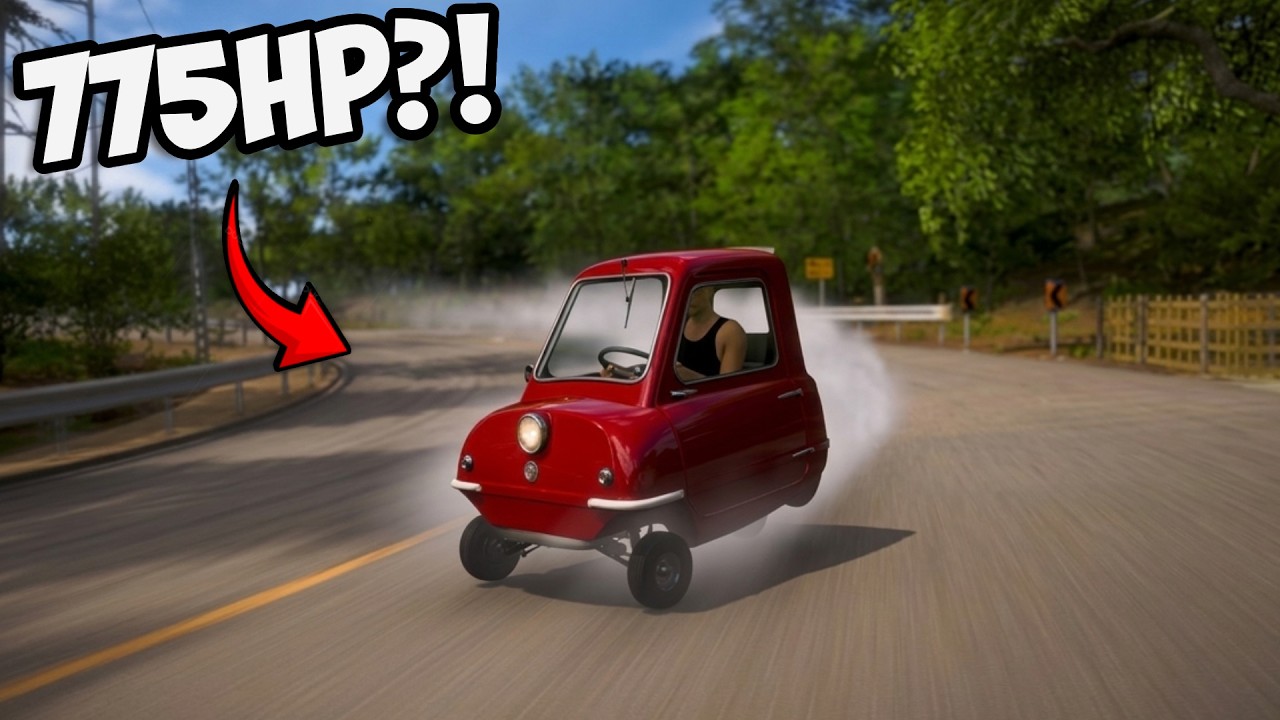
Forza Horizon 6 positions itself as an evolution of large-scale open-world racing, but player-driven experiments often expose the most interesting systems. One such community-style session revolved around two extreme scenarios: a bone-stock Peel P50 drag race and a full-length Goliath endurance run exceeding 50 miles.
What emerged wasn’t just racing—it was systems stress-testing, endurance management, and unintended multiplayer chaos layered on top of core driving mechanics.
1. Peel P50 Drag Test: Minimum-Speed Benchmarking
The first experiment used fully stock Peel P50s, one of the slowest drivable vehicles in the series, to establish a “lowest-performance baseline.”
Peel P50 Performance Snapshot
| Metric | Value |
| Vehicle | Peel P50 (stock) |
| Event Type | Quarter-mile drag race |
| Best Recorded Time | ~36.0 seconds |
| Average Speed | ~29–45 mph (platoon variance) |
| Stability Aids | Mixed (some disabled assists) |
| Outcome | Near-identical clustering, minor drafting effects |
Despite minimal mechanical differences, the race revealed unexpected behavior:
- Traction control removal had negligible benefit at ultra-low power levels
- Slipstreaming barely functioned due to extremely low top speeds
- Driver input variability (gear timing, throttle jitter) mattered more than tuning
The most surprising takeaway: at extremely low horsepower, skill expression shifts from speed optimization to micro-consistency management.
2. The Goliath Endurance Run: 53.1 Miles of Controlled Collapse
The second and far more significant experiment was a full Goliath circuit run, reportedly exceeding 53 miles, completed in roughly 90+ minutes depending on incidents.
Goliath Event Breakdown
| Category | Details |
| Distance | ~53.1 miles |
| Duration | ~90–94 minutes |
| Participants | 10–11 drivers |
| Terrain | Urban roads → mountain ascent → snow transition |
| Difficulty Factor | Continuous uphill segments + long straight fatigue |
| Failure Points | Disconnections, missed checkpoints, mis-shifts |
Key observation: endurance racing in FH6 is less about pace and more about error accumulation over time.
Mechanical Stress Factors Observed
| System | Observed Behavior |
| Gear shifting | Players defaulted to “second/third gear meta” to reduce mistakes |
| Auto driving | Disabled during race segments, increasing fatigue |
| Drafting | Emergent but inconsistent due to elevation changes |
| Cornering | Majority of time loss came from hairpins and uphill braking zones |
| Player fatigue | Physical controller strain became a limiting factor |
One of the most consistent strategies was deliberately avoiding upshifts to reduce cognitive load—turning the race into a semi-automatic rhythm endurance test.
3. Elevation, Snow, and the “Legend Island“ Problem
A major turning point was the transition into high-altitude terrain, referred to by players as “Legend Island.”
This segment introduced:
- Rapid elevation gain reducing vehicle speed ceiling
- Snow transition zones affecting traction perception
- Visibility changes due to lighting shifts
- Increased likelihood of checkpoint misses
Elevation Impact Table
| Segment | Avg Speed Impact | Driver Error Rate |
| Coastal roads | Minimal | Low |
| Forest ascent | Moderate slowdown | Medium |
| Mountain climb | Severe slowdown | High |
| Snow zone | Maximum instability | Very high |
At peak incline, even mid-gear acceleration failed to maintain forward momentum, effectively turning the race into a torque-limited crawl section.
4. Emergent Gameplay Systems: When FH6 Stops Being a Racing Game
While the event was structured as a race, most of the runtime was dominated by emergent behavior:
Non-Racing Activities Observed
- Ordering real-world food during the race
- Players switching to chess and GeoGuessr mid-event
- Temporary driver swaps using controller sharing
- Full disengagement during straight-line segments
- One participant disconnecting due to network instability
This highlights an important systemic truth:
Long-duration FH6 events effectively become “background simulation spaces” rather than focused races.
The game’s open-world persistence enables multitasking behavior that traditional racing titles cannot support.
5. Economy Layer: Credits, Rewards, and Player Motivation
Despite the scale of the event, reward expectations became a recurring discussion point.
Players speculated about whether long endurance events would properly scale payouts in FH6 Credits, especially given:
- Time investment (~1.5 hours)
- Difficulty spikes (mountain + snow segments)
- Player attrition (disconnects and fatigue)
Reward Expectation vs Reality
| Factor | Player Expectation | Observed Trend |
| Time investment | High payout | Uncertain scaling |
| Skill requirement | Moderate | Low-to-medium |
| Failure risk | High | Moderate |
| Reward scaling | Linear with duration | Potentially capped |
This naturally leads into the broader economy loop: players increasingly consider whether optimizing progression through gameplay alone is viable or whether accelerating progression via systems like Buy Forza Horizon 6 Credits becomes more efficient for experimentation builds and event variety.
6. System Design Insight: What This Session Actually Reveals
From a mechanical standpoint, the session unintentionally tested three major systems:
1. Long-distance race endurance design
FH6 supports extremely long-form events, but player fatigue becomes the true difficulty modifier.
2. Input degradation over time
Controller strain and attention loss significantly impact performance more than vehicle tuning.
3. Social persistence layer
Multiplayer chaos (voice chat, interruptions, multitasking) becomes part of the gameplay loop itself.
7. Key Takeaways for Players
- Ultra-slow vehicles amplify driver inconsistency more than mechanical tuning
- Long races shift from racing skill to endurance management
- Elevation changes are the primary hidden difficulty multiplier
- Multiplayer chaos is effectively a secondary game mode
- Reward structures tied to FH6 Credits should be evaluated against time investment, not just completion
Closing Observation
What started as a novelty Peel P50 race evolved into a full-scale endurance simulation of attention, coordination, and system stress-testing inside Forza Horizon 6.
The most important discovery wasn’t about speed, tuning, or even track design—it was that at extreme durations, the game stops being about cars entirely and becomes about how long players can maintain focus before reality interrupts the race.